The Audit as a Free Diagnostic
Customs does not belong to a single team. Procurement, sales, finance, supply chain and logistics each own a piece of it, and when HMRC audits, the gaps show up in the seams between them. For finance leaders, those gaps carry real duty and governance risk, including personal exposure for the Senior Accounting Officer in larger groups.
This article explains why customs is so hard to own, why patching after an audit tends to move the gap rather than close it, what a fit-for-purpose customs function looks like and where outside help fits.
The Audit Did Not Find Your Problem. It Found the Seams.
The audit is over. It was not a disaster, but it left questions. HMRC asked for the written import procedures, and discovered that what was on them wasn’t happening in reality. The audit trail turned out to live across four inboxes and a shared drive nobody had tidied since 2021. And when the officer asked who signs off on origin, three people gave three different answers.
Nothing in that audit created those problems. It revealed ones that were already there.
If you sit in finance and customs lives somewhere further down the organisation chart, this is worth your attention. It usually means the function was never designed. It grew. And a function that grew, rather than one that was built, tends to have gaps in exactly the places no one is looking.
Why Customs Is So Hard to Own
Here is the structural reason. Customs does not belong to a single team. It sits in the overlap of five.
- Procurement negotiates the import incoterms and, often without realising it, the origin position.
- Sales agrees the export incoterms and the destinations.
- Finance pays the duty and carries the governance risk.
- Supply chain decides where goods are sourced.
- Logistics, or an agent acting for them, files the declaration.
Between them, procurement, supply chain and finance also shape the valuation position.
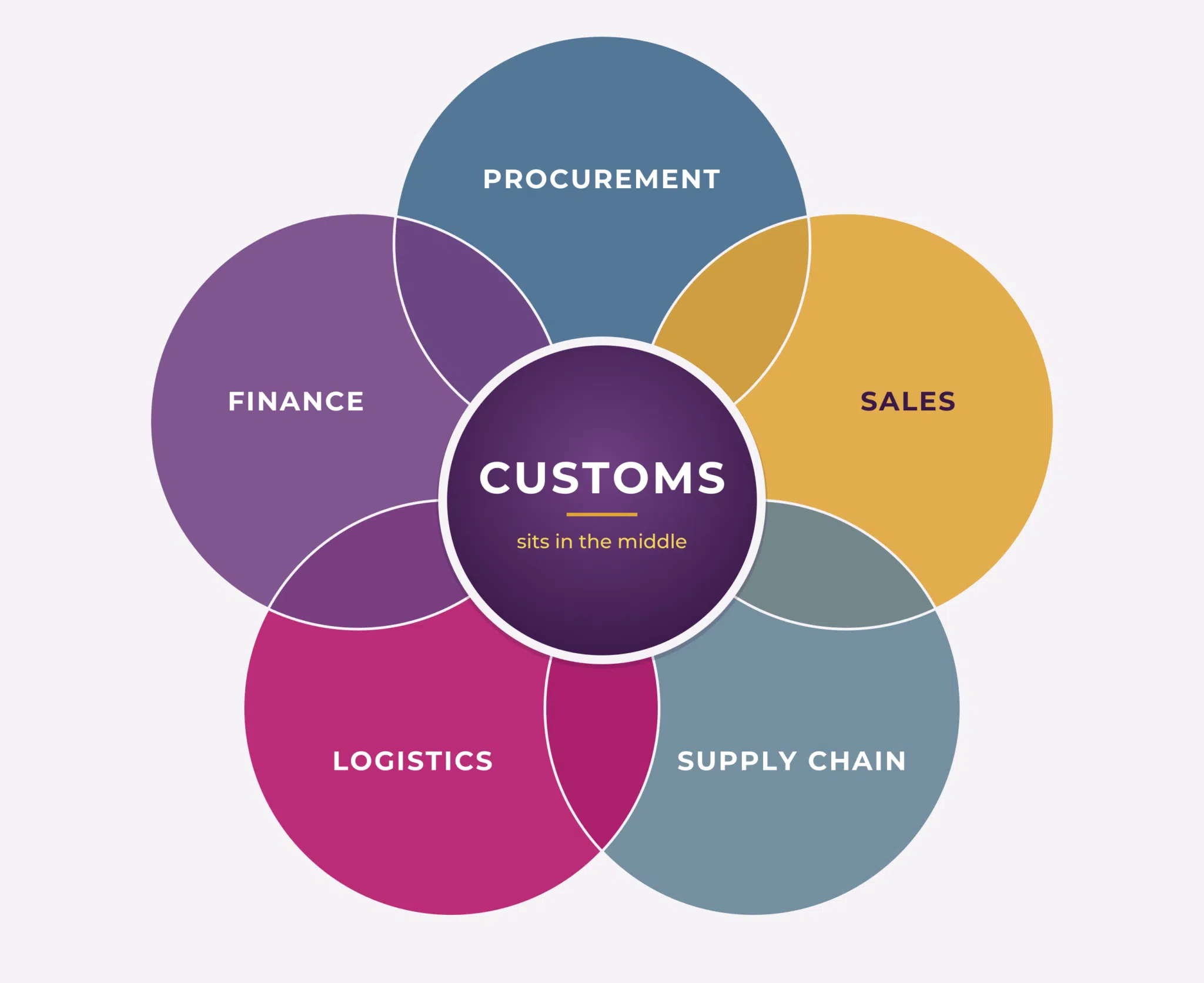
Five functions each own a piece. No single team owns the whole, and the gaps open in the seams between them.
Every one of those teams makes decisions with a customs consequence, and every one of them is measured on something else. The classification sits with one team, the value with another, the origin evidence with a third, and the person keying the entry usually sees none of the decisions that came before it.
The result is not a failing in any single team. It is gaps in the seams between them, and those gaps are where duty leakage and audit findings live.
If you have a customs specialist, they can usually point to those gaps with their eyes shut. What they tend to lack is the authority to reach across five departments and close them, or the hours to do it on top of clearing today’s shipments. The problem is rarely a shortage of knowledge; more often, it is a shortage of mandate and capacity.
And if your own background is finance rather than customs, you may feel the gaps without being able to name them. You are not a customs technician, and you should not have to become one. You can see that duty is a real number, that the audit went less smoothly than it should have, and that no one can give you a straight answer on who owns what. That instinct is usually correct.
Why Patching Does Not Hold
The temptation after an audit is to bolt on fixes. Write the one procedure the officer asked for. Tidy the folder. Name someone the owner. It feels like progress, and it buys a quiet quarter.
Fixes bolted onto a function that was never designed tend to move the gap rather than close it. Name an owner without giving them authority over procurement and logistics, and you have a title, not control. Write one procedure into a process no one has mapped, and you have a document that describes a step in isolation.
The more useful question is not ‘what did the audit flag’ but ‘would this function survive being looked at properly’. Answering that honestly sometimes means accepting that what you have was never built for the job it now does, and that the cleaner route is to strip it back and rebuild around a clear picture of who does what.
That is not a case for tearing everything up on day one. It is a case for a gap analysis first. Map what you do now against what good looks like, then decide what to keep, what to repair and what to rebuild. Some of it will be sound. Some of it will need to go. You cannot make that call until you can see the whole thing on one page.
What a Fit-for-Purpose Customs Function Looks Like
It is not hard to describe.
- One team owns oversight.
- The import and export processes are mapped, with the checks and controls marked and a name against each step.
- The procedures are written down, so they outlast the person who wrote them.
- There is an audit trail that cross-references to the commercial paperwork, so a request from HMRC is a five-minute retrieval rather than a fortnight of archaeology.
- Core elements such as classification, origin and valuation can be evidenced on request.
For the larger end of the market, this is not discretionary. Customs duty is one of the taxes a Senior Accounting Officer must personally certify, alongside VAT and corporation tax, once a group passes £200m in turnover or £2bn in assets, and the SAO can be fined personally where the arrangements are inadequate. Below that threshold the statutory hook falls away, but the logic does not. Duty under management, what you pay plus what you save through trade agreements and special procedures, is often far larger than finance realises until someone totals it up. Numbers that size deserve a function built on purpose.
Where an Outside Pair of Hands Fits
It is worth being precise about what outside help does and does not mean, because the fear is usually the wrong one. It does not mean marking your customs team’s homework. The good ones already know what needs doing. It means bringing three things they are rarely given: the cross-functional pull to get procurement, finance, supply chain, sales and logistics around one table, a blueprint of what good looks like drawn from having built it before, and, above all, the capacity to do the doing while your team keeps the goods moving.
Someone to run the gap analysis, write the procedures and process maps, project manage the build to a timescale, and break it into pieces small enough that no one is overwhelmed. Not a report that confirms what you already suspected. The build itself.
If you have just come through a tricky audit, or you carry that quieter sense that customs is not quite in your grip, treat the audit as the free diagnostic it was. It has already done the first piece of work. It showed you the seams.
A function that grew can be rebuilt, and it starts with an honest map.
If you would value a clear-eyed look at where your customs function stands, and what it would take to make it fit for purpose, we are glad to begin with the gap analysis.
Where does your customs function stand?
Book an exploratory call with one of our team to talk through where your customs function stands today and what a gap analysis would involve.
Or email Adam Wood at [email protected]
Sources and Notes
Senior Accounting Officer regime: customs duty is a covered tax; personal penalty of £5,000 for inadequate arrangements; applies to UK groups above £200m turnover or £2bn balance-sheet assets (HMRC; ClearBorder, 2024).
‘Duty under management’ and the phased build (control and management, audit trail, origin) reflect Barbourne Brook’s customs function methodology.
Contact Our Team …
Related Posts


What You Can’t Explain, You Can’t Control: The Visibility Gap in Supply Chain Customs
A supply chain director who has told…